
Co-Founder at PhysioFIT·October 28, 2026·12 min read
The short answer: You are ready to return to running after Achilles surgery when your calf proves it can handle the load, not when a calendar says enough time has passed. Running places enormous force demands on the Achilles and soleus, and clearing yourself based on "it feels fine" is how re-ruptures happen. At PhysioFIT, we use force-plate testing to confirm three things before your first stride: your soleus peak force has returned to acceptable levels, your Limb Symmetry Index is within a clinically meaningful range, and you can tolerate repeated hopping without pain or asymmetry.
Why Running After Achilles Surgery Is Not Like Running After Other Injuries
Returning to running after Achilles tendon repair is a fundamentally different challenge than coming back from a hamstring strain, a knee sprain, or even conservative Achilles tendinopathy management. If you are managing tendinopathy without surgery, the return-to-run process is different; see our tendinopathy treatment guide for that approach. For post-surgical patients, the challenge comes down to one thing: your tendon was surgically reconstructed, and the forces running places on that repair are extreme.
Your soleus, the deep calf muscle responsible for the majority of push-off force during running, handles approximately 85% of your peak calf force output with every stride. That number is not a typo. Your soleus absorbs more load during a simple jog than most people realize, and unlike a hamstring or a quad, you cannot offload it. Every step goes through it.
Published biomechanical data also shows that the entire calf muscle-tendon unit (MTU) contributes roughly 35 to 40% of total lower-body work during running, sprinting, and cutting. After months of post-surgical immobilization and restricted loading, your calf is profoundly weaker than it was before surgery. Running on a calf that has not been objectively tested for readiness is not just a setback risk. It is a re-rupture risk.
This is why Achilles tendon surgery recovery timelines average approximately 11 months to full return-to-sport. Not because the tendon takes that long to heal structurally, but because the surrounding muscles, particularly the soleus, need that long to rebuild the force capacity that running demands.
If you are earlier in your recovery and looking for a full overview of the post-surgical rehab process, see our Achilles Tendon Rehab service page for a complete phase-by-phase breakdown.
The Three Criteria You Must Meet Before Your First Run
At PhysioFIT, we do not clear anyone for running after Achilles surgery based on weeks post-op. We use a criteria-based model adapted from current rehabilitation evidence (Green et al., 2022). All three of the following must be met:
1. Achieve an Accepted Strength Threshold
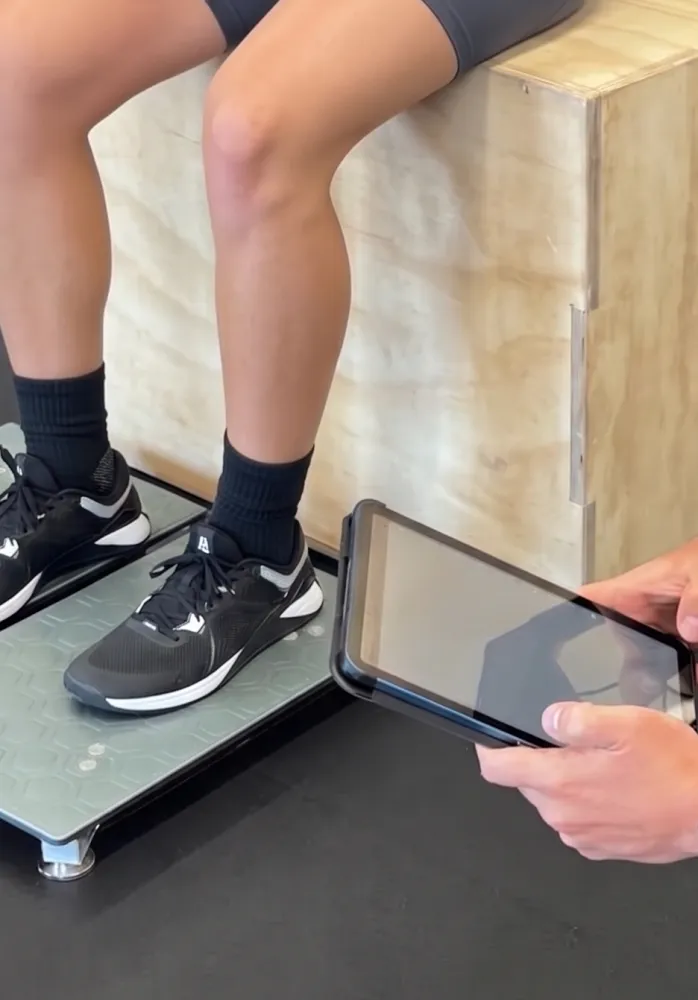
Your soleus and gastrocnemius must demonstrate sufficient peak force production, measured objectively on force plates. We test this two ways:
Seated plantar flexion MVIC (maximal voluntary isometric contraction) isolates your soleus by bending the knee and reducing gastrocnemius contribution. This is the most important test because your soleus is the muscle that does the majority of the work during running and is the muscle most affected by post-surgical atrophy.
Standing plantar flexion MVIC engages both the soleus and gastrocnemius together, measuring your total calf force capacity.
Your results are compared to three benchmarks: your healthy (non-surgical) leg, your pre-injury baseline if available, and population-level normative data. We use all three because research (O'Neill et al., 2019) has shown that even the uninjured calf in Achilles patients often produces less force than healthy age-matched controls. Comparing only to your opposite leg can give you a falsely reassuring number.
2. Tolerate Repeated Hopping
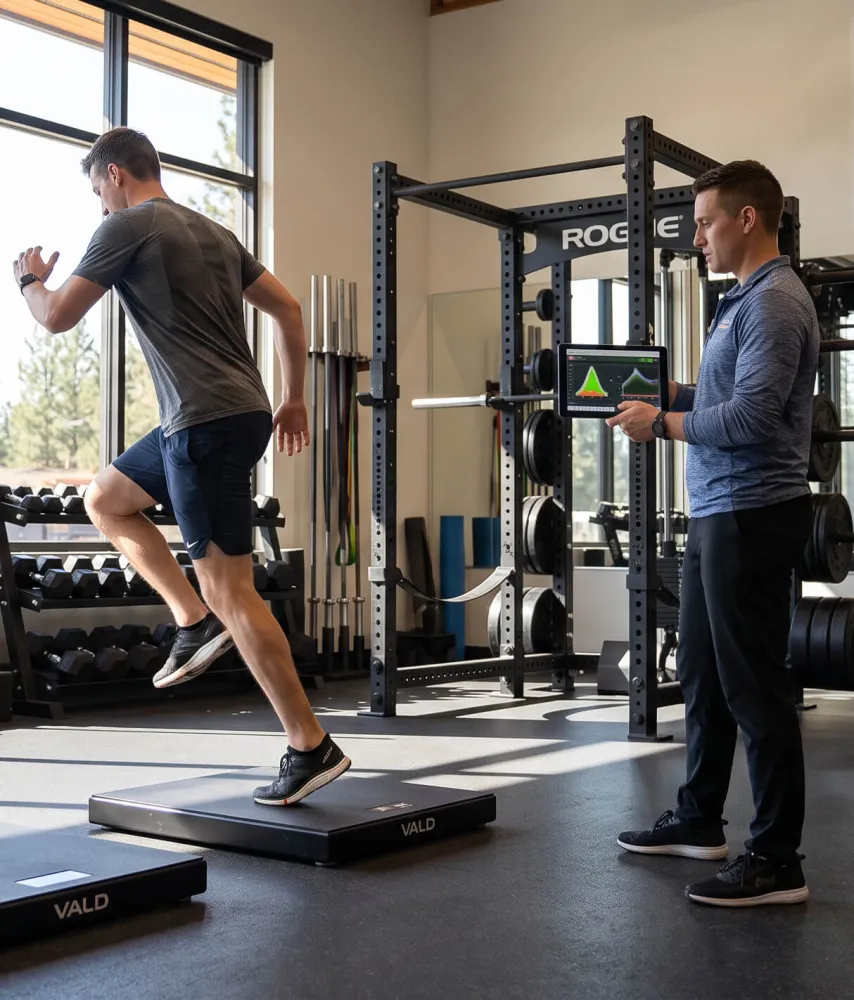
Running is not just about raw strength. It is about your calf's ability to handle rapid, repetitive impact loading. Before your first run, you need to demonstrate hop test tolerance across multiple formats:
- 10-5 Hop Test: Measures your reactive strength index (RSI), which captures how quickly and powerfully your calf can produce force during ground contact.
- 60-Second Hop Test: Evaluates your calf's endurance under repeated plyometric stress, tracking both performance and fatigue response over a sustained period.
- Countermovement Rebound Jump: Assesses your slow stretch-shortening cycle capacity, which is the spring-like energy storage mechanism your calf MTU relies on during running.
All of these are measured on force plates. We track your drive-off force asymmetry, comparing your surgical leg to your healthy leg. We also track your RSI to confirm both legs are contributing equally. If your surgical leg is compensating by using more quadriceps and less ankle, the force plate data reveals it even when you feel balanced.
3. Absence of Clinical Signs and Symptoms
This is the simplest criterion but still matters: no pain during walking, full weight-bearing dorsiflexion range of motion, and no residual swelling or tenderness at the repair site. Symptoms alone are not enough to clear you for running, but their presence is a reliable signal that you are not ready.
Why "It Feels Fine" Is Not Enough
This is the hardest part for most patients to accept. By the time you are approaching running readiness, your daily life probably feels completely normal. You are walking without a limp. Stairs are easy. You may even be doing single-leg calf raises. It feels like you should be running.
But there is a significant gap between what your calf can do in daily life and what running demands. Here is a practical way to think about it:
| Activity | Approximate Calf Force Demand |
|---|---|
| Walking | 1.0 to 1.5x bodyweight per step |
| Stair climbing | 1.5 to 2.0x bodyweight per step |
| Slow jogging | 2.5 to 3.0x bodyweight per step |
| Running at moderate pace | 3.0 to 4.0x bodyweight per step |
| Sprinting and cutting | Up to 12x bodyweight through the calf MTU |
Force values are approximate ranges from published biomechanical research and vary based on running speed, technique, and body composition.
The jump from pain-free walking to slow jogging is not incremental. It is a roughly 2x increase in force demand on every single step. If your soleus has only recovered 60% of its pre-injury capacity, you may feel completely fine walking (which only needs about half of that capacity) while being dangerously underprepared for the impact loading of running.
This is exactly why force-plate testing exists. It quantifies what "feeling fine" cannot.
Ready to find out where your calf strength stands?
Book your Achilles AssessmentWhat a Graduated Running Reconditioning Program Looks Like
A graduated program starts with walk-run intervals and progresses over 8 to 12 weeks through continuous running, mileage building, and terrain reintroduction, with force-plate testing at each stage to confirm your calf is tolerating the load.
Once you have met all three clearance criteria, you do not go out and run three miles. The reconditioning process is methodical, and it differs from standard return-to-run programs because of the outsized force demands the calf MTU absorbs even at slow running speeds.
The following is a general framework. Your specific intervals and progressions will be adjusted based on your force-plate data, your sport goals, and your response to each session.
Weeks 1 to 2: Walk-Run Intervals
Start with alternating walk-run intervals on flat, even terrain. A common starting point is 1 minute of running followed by 2 to 3 minutes of walking, repeated for 15 to 20 minutes total. The running segments should be at a conversational pace, slower than you think you need.
What to monitor: Pain should stay at or below a 2 out of 10 during the run, and your calf should feel back to baseline by the next morning. If it does, the session was appropriate. If soreness lingers into the following day, reduce the running intervals and extend the walking intervals.
Weeks 3 to 4: Increase Running Volume
Gradually shift the ratio toward more running and less walking. Progress from 1:2 (run:walk) to 1:1, then to 2:1. Total session time stays around 20 to 25 minutes. Keep the pace conversational.
Key principle: Increase volume before increasing speed. Mileage comes first. Pace and intensity come later. This is the opposite of what many runners instinctively want to do, but it is essential for protecting your repair. Speed and hill running spike calf MTU load dramatically, and your calf needs to build baseline endurance before handling those demands.
Weeks 5 to 8: Continuous Running and Gradual Mileage Build
Transition to continuous running (no walk breaks). Build mileage slowly, adding no more than 10 to 15% per week. Stay on flat terrain. Avoid trails with technical footing, significant elevation, or uneven surfaces for now.
Weeks 8 to 12: Reintroduce Terrain and Pace
Once you are running continuously for 25 to 30 minutes without symptoms, you can begin reintroducing gentle hills, light trail surfaces, and modest pace increases. This is also when we begin adding sport-specific drills (lateral movement, cutting, acceleration) for athletes who need to return to court or field sports.
Ongoing: Force Testing Does Not Stop
Even after you are running comfortably, we continue testing your plantar flexion peak force and tracking your fatigue response. Published data suggests that force or endurance deficits exceeding 20% during the early return-to-sport window may indicate poor fatigue resistance, which is associated with elevated reinjury risk.
This monitoring catches problems before they become injuries. A calf that is slowly losing force capacity under the accumulated stress of running will show up on the force plate before it shows up as pain.
The Five Mistakes That Derail Achilles Return-to-Run
The most common mistakes are running based on a calendar date rather than strength data, skipping plyometric preparation, increasing speed before building volume, neglecting soleus-specific testing, and stopping strength training once running begins.
These are the patterns I see most often in patients who come to us after a stalled or failed return to running:
- Running based on a calendar date. "My surgeon said 16 weeks" is not a clearance. It is a general guideline. Without objective strength data, 16 weeks could be too early for one person and unnecessarily late for another.
- Skipping the hopping phase. Many rehab programs go straight from calf raises to running. Running is a plyometric activity. If you cannot tolerate repeated hopping on your surgical leg, you are not ready to run. Hopping is the bridge.
- Increasing speed before volume. The natural impulse is to "test" your calf with a faster pace once running feels easy. But pace increases spike the force through your calf MTU disproportionately compared to mileage increases. Build the volume base first.
- Ignoring the soleus. Many standard rehab programs test calf strength with standing calf raises only. Standing calf raises engage your gastrocnemius and soleus together, which can mask a significant soleus deficit. If your rehab has never tested your soleus independently with a seated plantar flexion test, you have a blind spot.
- Stopping strength training once running begins. Running does not maintain your calf strength. It challenges your calf endurance. Strength training (particularly heavy isometric and loaded plantar flexion work) must continue alongside your running reconditioning to maintain and continue building the peak force capacity that protects your repair.
How Bend Runners Get Back on the Trails at PhysioFIT
At PhysioFIT in Bend, we use VALD force-plate technology and a criteria-based protocol to objectively clear runners for return to trail and road running after Achilles surgery.
Bend is a running town. Phil's Trail, the Deschutes River Trail, and the routes around Pilot Butte are what make this place home for a lot of our patients. Getting back to those trails after Achilles surgery is not just a fitness goal. It is a quality-of-life goal.
Whether you are a competitive trail runner aiming to return to ultra distances or a recreational jogger who just wants to do 3 miles without worrying, the process is the same: prove your calf can handle it, then build back methodically.
If you are currently in rehab and approaching the running conversation with your physical therapist, ask these three questions:
- What is my soleus peak force compared to my healthy leg and to age-matched norms?
- Can I tolerate repeated hopping on force plates without significant asymmetry?
- What does my graduated running reconditioning plan look like week by week?
If you are not getting specific, measurable answers, you may not be getting the precision your Achilles repair deserves.
Ready to find out if your calf is ready to run? Book your Achilles Assessment at PhysioFIT. | (541) 797-5800
Frequently Asked Questions
When can I run after Achilles surgery?
Published clinical data places the average return-to-sport timeline at approximately 11 months after Achilles tendon rupture repair. However, the honest answer is that calendar time is the wrong measure. Some patients are ready sooner; others need more time. At PhysioFIT, we clear patients for running when their soleus peak force, Limb Symmetry Index, and hop test tolerance all meet clinically acceptable thresholds on force plates.
Can I jog lightly before I am fully cleared?
In general, no. A "light jog" still places 2.5 to 3 times your bodyweight through your calf with every step. That is significantly more force than walking or stair climbing. Without confirming your calf can handle that load through objective testing, even a slow jog carries real risk to your repair.
How do I know if I am pushing too hard during my running reconditioning?
Use the next-morning rule: pain during your run should stay at or below a 2 out of 10, and your calf should feel back to its baseline by the time you wake up the next day. If soreness lingers into the next morning or escalates with each session, reduce your running volume and extend your walking intervals. Persistent or worsening symptoms after multiple sessions are a signal to reassess your strength and loading with your physical therapist.
Is returning to running after Achilles surgery different from returning to running with tendinopathy?
Yes, fundamentally. With tendinopathy (a degenerative overuse condition), you can often continue running in a managed way while loading and strengthening the tendon. After surgery, your tendon has been structurally repaired and needs to be protected through a criteria-based rebuilding process before it handles running forces. The force demands are the same, but the starting point and the risk profile are completely different. For a guide to managing Achilles tendinopathy without surgery, see our evidence-based tendinopathy treatment guide.
Do I need to keep doing strength training once I start running?
Yes. Running challenges your calf endurance but does not maintain your peak force. Continued strength training, particularly heavy isometric and loaded plantar flexion work, is essential to maintain the force capacity that protects your repair during the early return-to-run window. Stopping strength work once running begins is one of the most common mistakes we see.
What if I have been running but my calf keeps flaring up?
A calf that tolerates running for a few sessions but then flares is a classic sign of an endurance deficit or a hidden soleus weakness. The calf has enough peak force to handle individual sessions but not enough fatigue resistance to handle accumulated load over time. Force-plate testing after a maximal heel raise test can reveal this pattern. If you are experiencing recurring setbacks, an objective assessment can identify exactly where the gap is.
Please Note: The information on this page is for general education and is not a substitute for professional medical advice. Every surgical repair and every body is different, and a return-to-running program should be matched to your specific recovery, ideally with a qualified physical therapist who can test your readiness objectively. If you would like a plan built for your Achilles, or want to work with a physical therapist in Bend, Oregon, reach out at PhysioFITBend.com.