
Co-Founder at PhysioFIT·May 19, 2026·9 min read
If you're reading this, there's a good chance you just tore your ACL, or someone you love did. Maybe you're staring down a surgery date. Maybe it already happened and you're sitting on the couch wondering what the next nine months actually look like. That uncertainty is normal. It's also the hardest part of the early days. This guide walks you through the entire ACL rehab process at PhysioFIT in Bend, Oregon, not the clinical version, but the real one. What it feels like, what to expect at each stage, and how we'll measure whether you're genuinely ready to get back to the life you love.
Before Day 1, The Discovery Call
Your first interaction with PhysioFIT isn't a commitment. It's a conversation. We offer a free discovery call so you can ask questions, share your situation, and figure out whether we're the right fit before you ever walk through the door.
During the call, we'll want to know about your surgery date (or whether you're still deciding), your surgeon's protocol, and what activities matter most to you, skiing at Mt. Bachelor, trail running on Phil's Trail, CrossFit, or simply chasing your kids around Drake Park. These details shape the plan from day one.
If you have your MRI report, surgical notes, or a protocol from your orthopedic surgeon, bring those along to your first visit. If you don't have them yet, that's fine, we'll help you figure out what to request. The discovery call is low-pressure by design. You're not signing up for anything. You're finding out if this is the right place for you.
The First 6 Weeks, The Non-Negotiables
Let's be honest: the first six weeks are not glamorous. You won't be doing anything that looks like training. Sessions focus on three things that matter more than everything else combined: getting your knee straight, controlling swelling, and reactivating your quad.
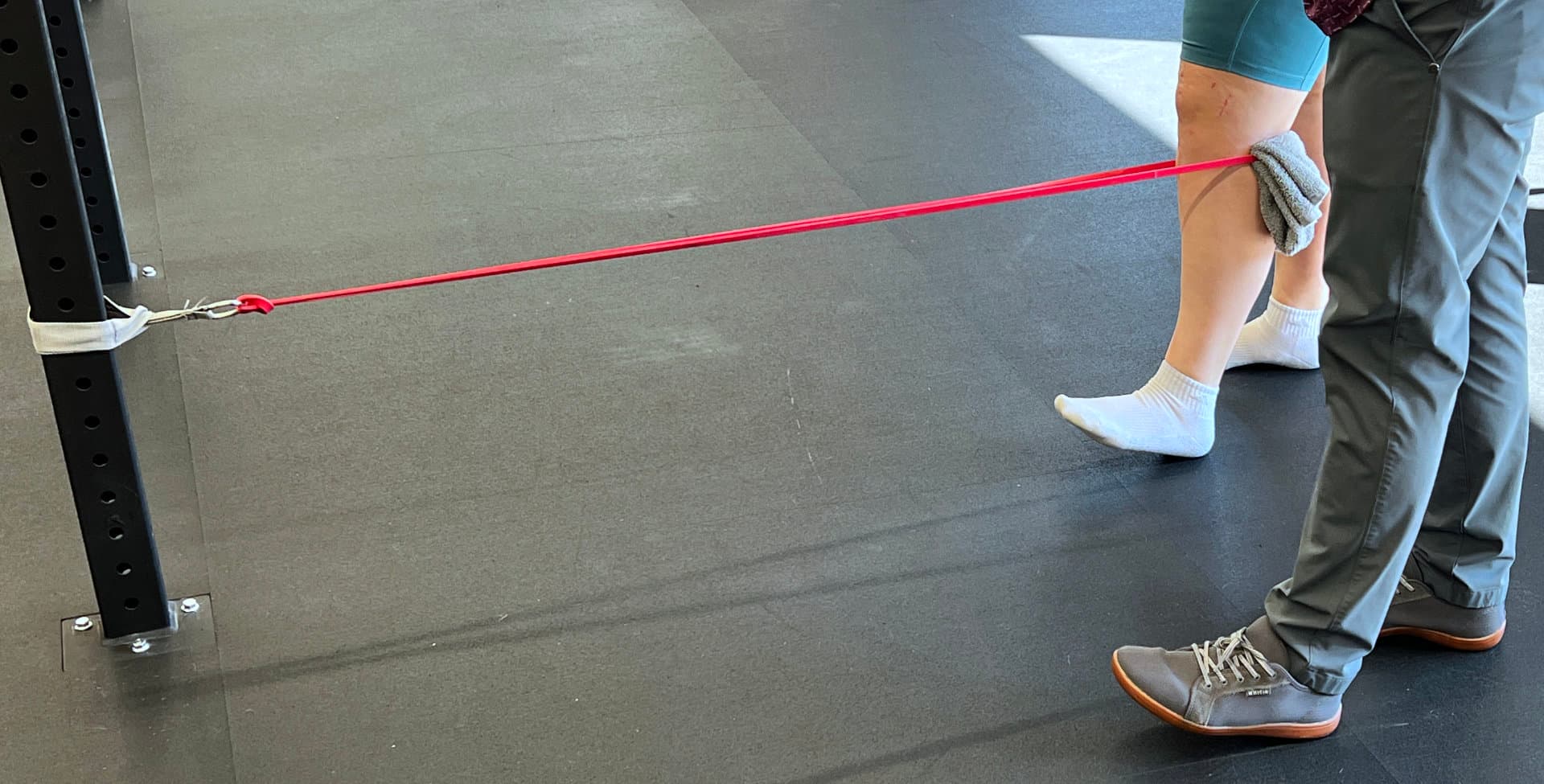
Your physical therapist will guide you through gentle range-of-motion work, patellar mobilizations, and isometric quad contractions. We use hands-on manual therapy to manage scar tissue and restore joint glide. You'll ice. A lot. You'll elevate. You'll do exercises that feel almost insultingly simple, heel slides, ankle pumps, quad sets.
Here's why these weeks matter so much: the graft your surgeon placed is at its weakest during this window. Rushing through this phase doesn't make you tough, it puts the entire reconstruction at risk. The patients who nail these first six weeks are the ones who fly through the later stages. The ones who skip ahead tend to hit walls at month four that they wouldn't have hit otherwise.
Expect to come in two to three times per week during this phase. Each session is one-on-one with your PT, not a rotation through a room of machines with a tech checking in. You'll leave with a clear home program and specific benchmarks for the following week.
Months 2–4, Building Real Strength
This is where things start to shift. Swelling is manageable, your range of motion is close to normal, and your graft is beginning to remodel. Now the work becomes about building genuine strength, not just endurance, but force production.
At PhysioFIT, we introduce objective strength testing using the VALD dynamometer. This isn't a subjective “looks good” assessment, it's a measured comparison between your surgical leg and your healthy leg, expressed as a Limb Symmetry Index (LSI). If your injured quad produces 60% of the force your healthy quad does, we know exactly where you stand and what needs to change.
You'll start hitting milestones that actually feel like progress: your first bodyweight squat to depth, your first single-leg press, step-ups that don't make you wince. It's genuinely rewarding after weeks of small movements.
But this phase also comes with a common emotional dip. The novelty of rehab has worn off. You're not in acute pain anymore, so motivation can slip. You see friends skiing or running on social media and wonder when it'll be your turn. We get it. We talk about this openly because pretending it doesn't happen doesn't help anyone. Your PT will adjust the program to keep it challenging and aligned with your goals, not just physically, but mentally.
Months 4–7, Power, Speed, and Sport-Specific Work
When your strength numbers hit the right thresholds, the program evolves again. This is the phase where rehab starts feeling like training. Plyometrics, lateral cutting, change-of-direction drills, deceleration work, movements that load the ACL the way real life does.
We use force-plate testing to measure how you land, how symmetrically you absorb impact, and whether your movement patterns are protecting the graft or stressing it. These aren't pass/fail checkboxes. They're data points that tell us exactly when to progress and when to hold.
One thing we emphasize at PhysioFIT: the timeline is criteria-based, not calendar-based. Hitting month five doesn't mean you're automatically ready for plyometrics. Hitting the strength, control, and confidence benchmarks does. Some people get there at four months. Some at six. Both are normal. The only wrong answer is advancing before your body is ready.
“Almost ready” has a specific feeling during this phase. You can do most of what you want to do. The hesitation starts to fade. You catch yourself moving without thinking about your knee for the first time. That's a milestone no test can measure, and your PT will notice it before you do.
Months 7–12, The Return-to-Sport Decision
Current research strongly supports waiting at least nine months before returning to pivoting, cutting, or contact sports after ACL reconstruction. Every month you delay return to sport before the nine-month mark reduces your re-tear risk significantly. This isn't a PhysioFIT opinion, it's backed by large-scale outcome studies across thousands of athletes.
The final return-to-sport battery at PhysioFIT includes a combination of strength testing (quad and hamstring LSI above 90%), hop testing (single-leg hop, triple hop, crossover hop), force-plate landing analysis, and sport-specific movement screening. We're looking for symmetry, confidence, and quality, not just raw numbers.
We coordinate with your orthopedic surgeon for final clearance and, when relevant, your coach or trainer. Everyone involved in your recovery should be on the same page about what “ready” actually means.
Clearance day carries real emotional weight. Some patients describe it as relief. Others feel a wave of anxiety they didn't expect. Suddenly the safety net of rehab is gone and the responsibility shifts back to you. Both reactions are completely normal, and our team prepares you for that transition well before it arrives.
After Clearance, Why Rehab Doesn't End at Discharge
Getting cleared to return to sport is a milestone, not a finish line. Re-injury rates after ACL reconstruction remain concerning, particularly in the first two years. The research is clear that athletes who continue structured strength and neuromuscular training after discharge have significantly lower re-tear rates than those who stop.
At PhysioFIT, we offer post-surgical maintenance programming that bridges the gap between rehab and independent training. This might mean a monthly check-in, a quarterly strength retest, or a full performance program designed around your sport. The goal is simple: make sure you don't just get back to where you were, you come back stronger.
Many of our ACL patients end up fitter and more resilient than they were before the injury. That's not a consolation prize. When you spend nine months systematically addressing every weakness, every asymmetry, every movement fault, the result is an athlete who moves better than they ever did. We see it constantly.
Common Questions We Hear
Will I be able to ski, climb, and run again?
The short answer for most people is yes. The longer answer is that your ability to return to high-level activity depends on how thoroughly you complete rehab, not just on the surgery itself. Central Oregon's outdoor lifestyle, skiing at Bachelor, mountain biking at Phil's, climbing at Smith Rock, is exactly why many of our patients push through the hard months. We build your program around the specific demands of the activities you want to return to. A skier needs different preparation than a runner, and we treat it that way.
What if I'm not an athlete?
You don't have to be. Plenty of our knee rehab patients are weekend hikers, parents who want to keep up with their kids, or people who simply want to walk downhill without their knee buckling. The process is the same, objective testing, progressive loading, criteria-based advancement, but the end goal is tailored to your life, not a sport.
How much will this cost?
Cost depends on your insurance plan, visit frequency, and the length of your rehab. We're transparent about pricing from the start. During your discovery call, our team will walk you through what to expect financially, help you verify your insurance benefits, and discuss cash-pay options if you prefer. No surprises at checkout.
Do I have to come in three times a week for the full nine months?
No. Visit frequency tapers as you progress. The early weeks are the most visit-intensive (typically two to three times per week). By months four through six, most patients shift to once or twice a week. In the final months, you may come in every other week for testing and programming updates while doing most of the work independently. The schedule flexes with your progress, not a rigid template.
Take the First Step
ACL rehab is a long road, but it doesn't have to be an uncertain one. At PhysioFIT, we measure everything, explain everything, and build a plan around your life, not a generic protocol. If you want the full clinical breakdown of our approach, visit our ACL rehab service page. If you're ready to talk to someone, book a free discovery call and let's figure out what the next nine months look like for you.
Please Note: The information provided on our website is intended for general education and is not a substitute for professional medical advice. Each individual's situation and body are different. Therefore, what may work for one person may not work for another. We care about your well-being and advise you to reach out to us to discuss your specific needs before implementing any advice from our website. If you'd like to explore this more or would like to schedule a time with a physical therapist in Bend Oregon, contact us at PhysioFITBend.com